
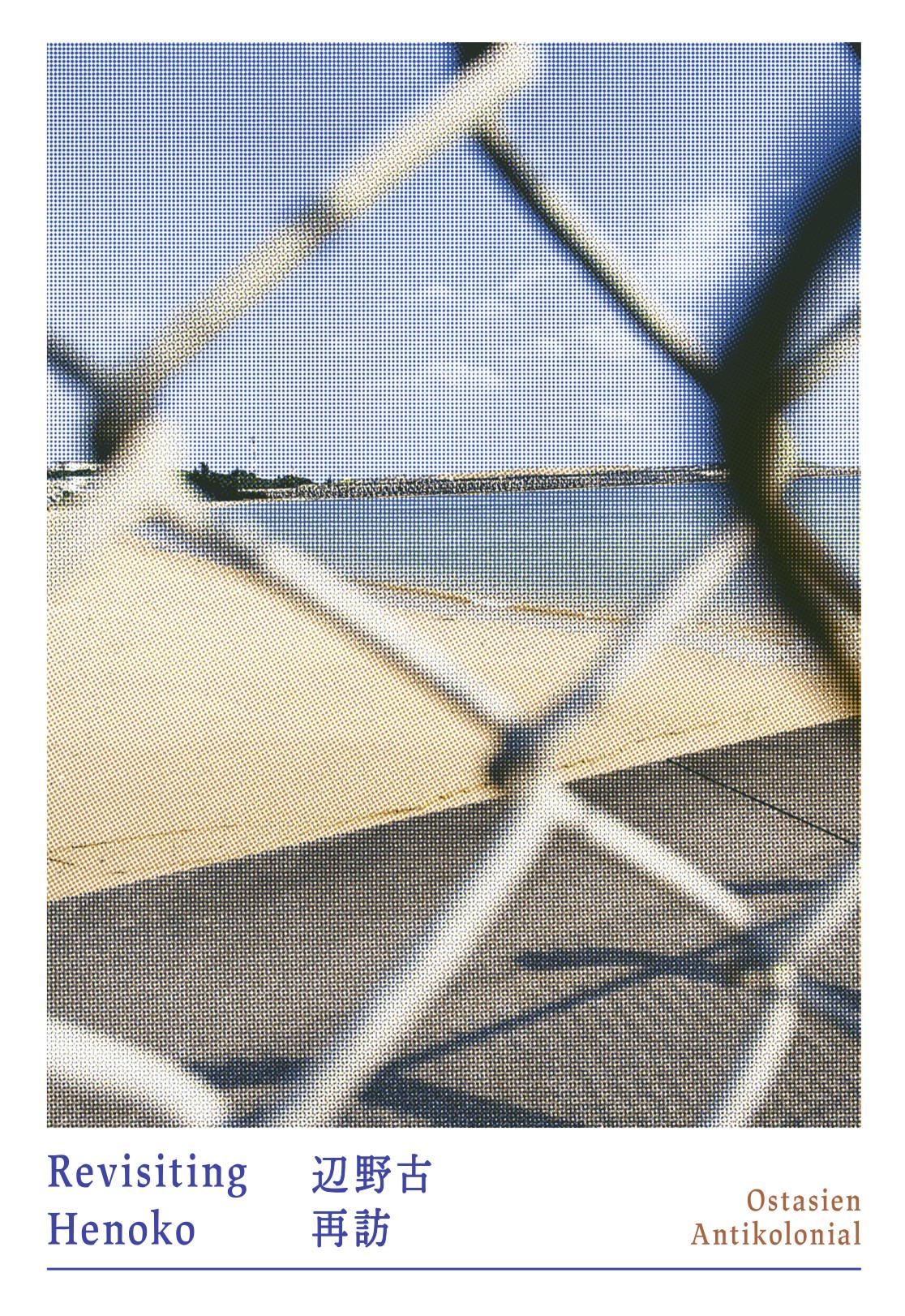
Our new zine, based on photos from our visit to Okinawa last December.
昨年12月に沖縄を訪問した際の写真をもとにZineを作りました。
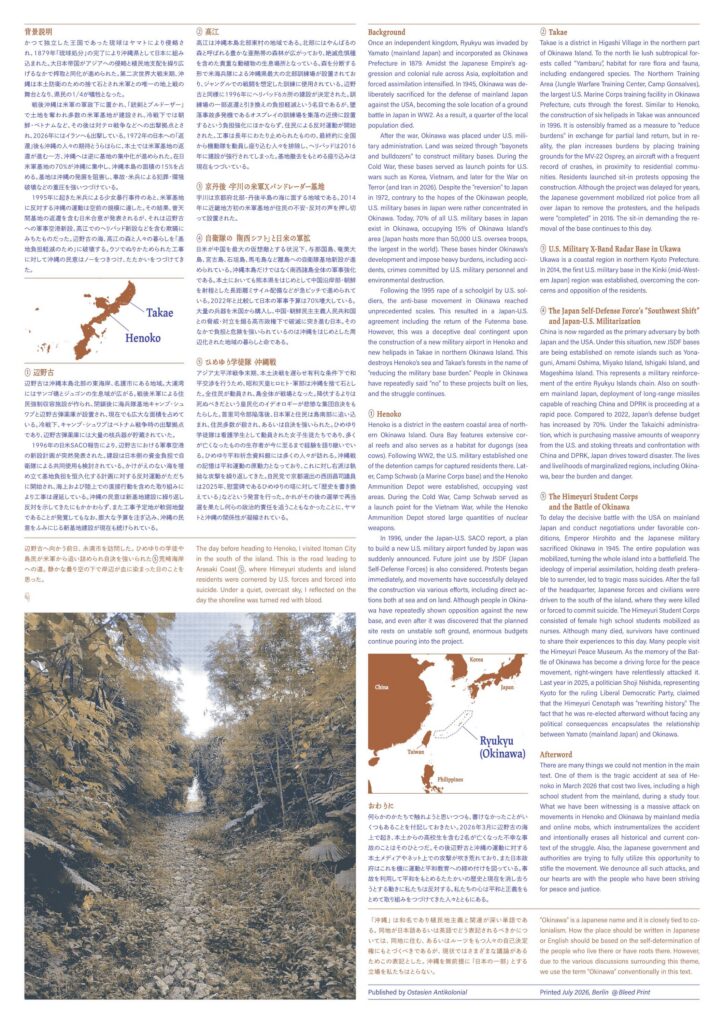
Background
Once an independent kingdom, Ryukyu was invaded by Yamato (mainland Japan) and incorporated as Okinawa Prefecture in 1879. Amidst the Japanese Empire’s aggression and colonial rule across Asia, exploitation and forced assimilation intensified. In 1945, Okinawa was deliberately sacrificed for the defense of mainland Japan against the USA, becoming the sole location of a ground battle in Japan in WW2. As a result, a quarter of the local population died.
After the war, Okinawa was placed under U.S. military administration. Land was seized through “bayonets and bulldozers” to construct military bases. During the Cold War, these bases served as launch points for U.S. wars such as Korea, Vietnam, and later for the War on Terror (and Iran in 2026). Despite the “reversion” to Japan in 1972, contrary to the hopes of the Okinawan people, U.S. military bases in Japan were rather concentrated in Okinawa. Today, 70% of all U.S. military bases in Japan exist in Okinawa, occupying 15% of Okinawa Island’s area (Japan hosts more than 50,000 U.S. oversea troops, the largest in the world). These bases hinder Okinawa’s development and impose heavy burdens, including accidents, crimes committed by U.S. military personnel and environmental destruction.
Following the 1995 rape of a schoolgirl by U.S. soldiers, the anti-base movement in Okinawa reached unprecedented scales. This resulted in a Japan-U.S. agreement including the return of the Futenma base. However, this was a deceptive deal contingent upon the construction of a new military airport in Henoko and new helipads in Takae in northern Okinawa Island. This destroys Henoko’s sea and Takae’s forests in the name of “reducing the military base burden.” People in Okinawa have repeatedly said “no” to these projects built on lies, and the struggle continues.
Henoko
Henoko is a district in the eastern coastal area of northern Okinawa Island. Oura Bay features extensive coral reefs and also serves as a habitat for dugongs (sea cows). Following WW2, the U.S. military established one of the detention camps for captured residents there. Later, Camp Schwab (a Marine Corps base) and the Henoko Ammunition Depot were established, occupying vast areas. During the Cold War, Camp Schwab served as a launch point for the Vietnam War, while the Henoko Ammunition Depot stored large quantities of nuclear weapons.
In 1996, under the Japan-U.S. SACO report, a plan to build a new U.S. military airport funded by Japan was suddenly announced. Future joint use by JSDF (Japan Self-Defense Forces) is also considered. Protests began immediately, and movements have successfully delayed the construction via various efforts, including direct actions both at sea and on land. Although people in Okinawa have repeatedly shown opposition against the new base, and even after it was discovered that the planned site rests on unstable soft ground, enormous budgets continue pouring into the project.
Takae
Takae is a district in Higashi Village in the northern part of Okinawa Island. To the north lie lush subtropical forests called “Yambaru”, habitat for rare flora and fauna, including endangered species. The Northern Training Area (Jungle Warfare Training Center, Camp Gonsalves), the largest U.S. Marine Corps training facility in Okinawa Prefecture, cuts through the forest. Similar to Henoko, the construction of six helipads in Takae was announced in 1996. It is ostensibly framed as a measure to “reduce burdens” in exchange for partial land return, but in reality, the plan increases burdens by placing training grounds for the MV-22 Osprey, an aircraft with a frequent record of crashes, in proximity to residential communities. Residents launched sit-in protests opposing the construction. Although the project was delayed for years, the Japanese government mobilized riot police from all over Japan to remove the protesters, and the helipads were “completed” in 2016. The sit-in demanding the removal of the base continues to this day.
U.S. Military X-Band Radar Base in Ukawa, Kyoto
Ukawa is a coastal region in northern Kyoto Prefecture. In 2014, the first U.S. military base in the Kinki (mid-Western Japan) region was established, overcoming the concerns and opposition of the residents.
The Japan Self-Defense Force’s “Southwest Shift” and Japan-U.S. Militarization
China is now regarded as the primary adversary by both Japan and the USA. Under this situation, new JSDF bases are being established on remote islands such as Yonaguni, Amami Oshima, Miyako Island, Ishigaki Island, and Mageshima Island. This represents a military reinforcement of the entire Ryukyu Islands chain. Also on southern mainland Japan, deployment of long-range missiles capable of reaching China and DPRK is proceeding at a rapid pace. Compared to 2022, Japan’s defense budget has increased by 70%. Under the Takaichi administration, which is purchasing massive amounts of weaponry from the U.S. and stoking threats and confrontation with China and DPRK, Japan drives toward disaster. The lives and livelihoods of marginalized regions, including Okinawa, bear the burden and danger.
The Himeyuri Student Corps and the Battle of Okinawa
To delay the decisive battle with the USA on mainland Japan and conduct negotiations under favorable conditions, Emperor Hirohito and the Japanese military sacrificed Okinawa in 1945. The entire population was mobilized, turning the whole island into a battlefield. The ideology of imperial assimilation, holding death preferable to surrender, led to tragic mass suicides. After the fall of the headquarter, Japanese forces and civilians were driven to the south of the island, where they were killed or forced to commit suicide. The Himeyuri Student Corps consisted of female high school students mobilized as nurses. Although many died, survivors have continued to share their experiences to this day. Many people visit the Himeyuri Peace Museum. As the memory of the Battle of Okinawa has become a driving force for the peace movement, right-wingers have relentlessly attacked it.
Last year in 2025, a politician Shoji Nishida, representing Kyoto for the ruling Liberal Democratic Party, claimed that the Himeyuri Cenotaph was “rewriting history.” The fact that he was re-elected afterward without facing any political consequences encapsulates the relationship between Yamato (mainland Japan) and Okinawa.
Afterword
There are many things we could not mention in the main text. One of them is the tragic accident at sea of Henoko in March 2026 that cost two lives, including a high school student from the mainland, during a study tour.
What we have been witnessing is a massive attack on movements in Henoko and Okinawa by mainland media and online mobs, which instrumentalizes the accident and intentionally erases all historical and current context of the struggle. Also, the Japanese government and authorities are trying to fully utilize this opportunity to stifle the movement. We denounce all such attacks, and our hearts are with the people who have been striving for peace and justice.
“Okinawa” is a Japanese name and it is closely tied to colonialism. How the place should be written in Japanese or English should be based on the self-determination of the people who live there or have roots there. However, due to the various discussions surrounding this theme, we use the term “Okinawa” conventionally in this text.
背景説明
かつて独 立した 王 国 であった 琉 球 はヤマトにより侵 略され、1879年「琉球処分」の完了により沖縄県として日本に組み込まれた。大日本帝国がアジアへの侵略と植民地支配を繰り広げるなかで搾取と同化が進められた。第二次世界大戦末期、沖縄は本土防衛のための捨て石とされ米軍との唯一の地上戦の舞台となり、県民の1/4が犠牲となった。
戦後沖縄は米軍の軍政下に置かれ、「銃剣とブルドーザー」で土地を奪われ多数の米軍基地が建設され、冷戦下では朝鮮・ベトナムなど、その後は対テロ戦争などへの出撃拠点とされ、2026年にはイランへも出撃している。1972年の日本への「返還」後も沖縄の人々の期待とうらはらに、本土では米軍基地の返還が進む一方、沖縄へは逆に基地の集中化が進められた。在日米軍基地の70%が沖縄に集中し、沖縄本島の面積の15%を占める。基地は沖縄の発展を阻害し、事故・米兵による犯罪・環境破壊などの重圧を強いつづけている。
1995年に起きた米兵による少女暴行事件のあと、米軍基地に反対する沖縄の運動は空前の規模に達した。その結果、普天間基地の返還を含む日米合意が発表されるが、それは辺野古への軍事空港新設、高江でのヘリパッド新設などを含む欺瞞にみちたものだった。辺野古の海、高江の森と人々の暮らしを「基地負担軽減のため」に破壊する。ウソでぬりかためられた工事に対して沖縄の民意はノーをつきつけ、たたかいをつづけてきた。
辺野古
辺野古は沖縄本島北部の東海岸、名護市にある地域。大浦湾にはサンゴ礁とジュゴンの生息域が広がる。戦後米軍による住民強制収容施設が作られ、閉鎖後に海兵隊基地キャンプ・シュワブと辺野古弾薬庫が設置され、現在でも広大な面積を占めている。冷戦下、キャンプ・シュワブはベトナム戦争時の出撃拠点であり、辺野古弾薬庫には大量の核兵器が貯蔵されていた。
1996年の日米SACO報告により、辺野古における軍事空港の新設計画が突然発表された。建設は日本側の資金負担で自衛隊による共同使用も検討されている。かけがえのない海を埋め立て基地負担を恒久化する計画に対する反対運動がただちに開始され、海上および陸上での直接行動を含めた取り組みにより工事は遅延している。沖縄の民意は新基地建設に繰り返し反対を示してきたにもかかわらず、また工事予定地が軟弱地盤であることが発覚してもなお、膨大な予算を注ぎ込み、沖縄の民意をふみにじる新基地建設が現在も続けられている。
高江
高江は沖縄本島北部東村の地域である。北部にはやんばるの森と呼ばれる豊かな亜熱帯の森林が広がっており、絶滅危惧種を含めた貴重な動植物の生息場所となっている。森を分断する形で米海兵隊による沖縄県最大の北部訓練場が設置されており、ジャングルでの戦闘を想定した訓練に使用されている。辺野古と同様に1996年にヘリパッド6カ所の建設が決定された。訓練場の一部返還と引き換えの負担軽減という名目であるが、墜落事故多発機であるオスプレイの訓練場を集落の近傍に設置するという負担強化にほかならず、住民による反対運動が開始された。工事は長年にわたり止められたものの、最終的に全国から機動隊を動員し座り込む人々を排除し、ヘリパッドは2016年に建設が強行されてしまった。基地撤去をもとめる座り込みは現在もつづいている。
京丹後・宇川の米軍Xバンドレーダー基地
宇川は京都府北部・丹後半島の海に面する地域である。2014年に近畿地方初の米軍基地が住民の不安・反対の声を押し切って設置された。
自衛隊の「南西シフト」と日米の軍拡自衛隊の「南西シフト」と日米の軍拡
日米が中国を最大の仮想敵とする状況下、与那国島、奄美大島、宮古島、石垣島、馬毛島など離島への自衛隊基地新設が進められている。沖縄本島だけではなく南西諸島全体の軍事強化である。本土においても熊本県をはじめとして中国沿岸部・朝鮮を射程とした長距離ミサイル配備などが急ピッチで進められている。2022年と比較して日本の軍事予算は70%増大している。
大量の兵器を米国から購入し、中国・朝鮮民主主義人民共和国との脅威・対立を煽る高市政権下で破滅に突き進む日本。そのなかで負担と危険を強いられているのは沖縄をはじめとした周辺化された地域の暮らしと命である。
ひめゆり学徒隊・沖縄戦
アジア太平洋戦争末期、本土決戦を遅らせ有利な条件下で和平交渉を行うため、昭和天皇ヒロヒト・軍部は沖縄を捨て石とした。全住民が動員され、島全体が戦場となった。降伏するよりは死ぬべきだという皇民化のイデオロギーが悲惨な集団自決をもたらした。首里司令部陥落後、日本軍と住民は島南部に追い込まれ、住民多数が殺され、あるいは自決を強いられた。ひめゆり学徒隊は看護学生として動員された女子生徒たちであり、多くが亡くなったものの生存者が今に至るまで経験を語り継いでいる。ひめゆり平和祈念資料館には多くの人々が訪れる。沖縄戦の記憶は平和運動の原動力となっており、これに対し右派は執拗な攻撃を繰り返してきた。自民党で京都選出の西田昌司議員は2025年、慰霊碑であるひめゆりの塔に対して「歴史を書き換えている」などという発言を行った。かれがその後の選挙で再当選を果たし何らの政治的責任を追うこともなかったことに、ヤマトと沖縄の関係性が凝縮されている。
おわりに
何らかのかたちで触れようと思いつつも、書けなかったことがいくつもあることを付記しておきたい。2026年3月に辺野古の海上で起き、本土からの高校生を含む2名が亡くなった不幸な事故のことはそのひとつだ。その後辺野古と沖縄の運動に対する本土メディアやネット上での攻撃が吹き荒れており、また日本政府はこれを機に運動と平和教育への締め付けを図っている。事故を利用して平和をもとめるたたかいの歴史と現在を消し去ろうとする動きに私たちは反対する。私たちの心は平和と正義をもとめて取り組みをつづけてきた人々とともにある。
「沖縄 」は和名であり植民地主義と関連が深い単語である。同地が日本語あるいは英語でどう表記されるべきかについては、同地に住む、あるいはルーツをもつ人々の自己決定権にもとづくべきであるが、現状ではさまざまな議論があるためこの表記とした。沖縄を無前提に「日本の一部」とする立場を私たちはとらない。